Is your work plagiarised?
Your teachers will use a program like PlagScan or Turnitin to check your work. Unfortunately these are licensed, so you can’t check it yourself. Instead, try one of these free online checkers: https://plagiarismdetector.net/ or https://www.quetext.com/.
Think you know what plagiarism is?
Can you pass this quiz about plagiarism? http://en.writecheck.com/plagiarism-quiz
No, you can’t copy and paste and change a few words.
Many students copy and paste information, and then change a few words. This is a common error in high school student’s work.
Even if you change a few words, this is still plagiarism, and our plagiarism checkers will find it.
Do not copy and paste information in whole sentences.
You need to write entirely in your own words.
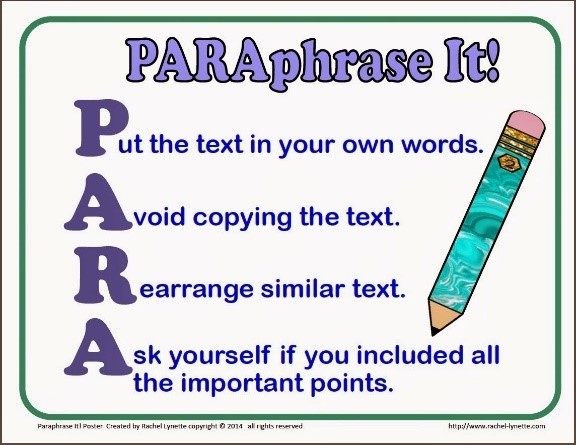
To do this, you need to paraphrase.
How to Write in your Own Words (Paraphrasing)
Step One: When you are finding information, make sure you take dot point notes.
- Do not copy and paste whole sentences.
- Do not write notes in full sentences.
- Keep a record of where each piece of information comes from. Tip: I use a different colour per information source.
Step Two: Organise all of your dot pointed information into groups.
- Tip: I use sticky notes for this. Write your dot points on sticky notes, one colour per original source. Then I group them into similar information.
Step Three: Write your information using only your dot points.
- Do not look at the original information until you’ve finished writing.
Need more help? Try: http://studyskills.curtin.edu.au/better-referencing/paraphrasing-and-summarising/ or:
 Ms Roberts' Lesson Stuff